How to Scale Teacher Professional Learning Programs


Introduction
In fall 2018, the American Institutes for Research® (AIR®) led a 6-year, multiphase partnership focused on an evidence-based professional learning program for elementary teachers. The program, Professional Learning with Impact (PLI), helps teams of teachers develop their skills using The Danielson Group’s Framework for Teaching (FFT).

This story shares insights from the project's scaling phase (2023–24) presented in 3 sections:
- Section 1. Challenges that shaped our approach to the scaling phase of the project;
- Section 2. Key insights that may help others scale the use of the FFT or other professional learning programs; and
- Section 3: District stories from each of the four districts that participated in this phase.
This story draws on interview data from 11 respondents in four districts that participated in the project’s scaling phase. AIR also conducted an impact evaluation examining the impacts the program had on teachers and students after a two-year version of the program (2021-2023).




What is the PLI program?
The PLI program was developed by two organizations at the forefront of teacher professional learning.
The Danielson Group and Learning Forward used resources developed by both organizations to create the PLI program.
The active ingredient in the PLI program is The Danielson Group's FFT, a comprehensive tool for teacher self-assessment and reflection, observation and feedback, and collaborative inquiry that specifies several dimensions of an educator's professional practice. Prior randomized controlled trials have shown that feedback on teaching based on the FFT has positive impacts on student achievement.
To incorporate the FFT into additional approaches to professional learning, The Danielson Group and Learning Forward support local instructional coaches, who use the FFT while working with grade-level teams to implement two of the PLI program’s primary components. Specifically, the coaches:
- Facilitate cycles of collaborative inquiry through meetings of the grade-level teams in what are called teacher learning team (TLT) meetings; and
- Provide one-on-one coaching that uses the goals of the grade-level team as a starting point.
As part of the scaling phase, The Danielson Group and Learning Forward added a school leadership support component to the program.

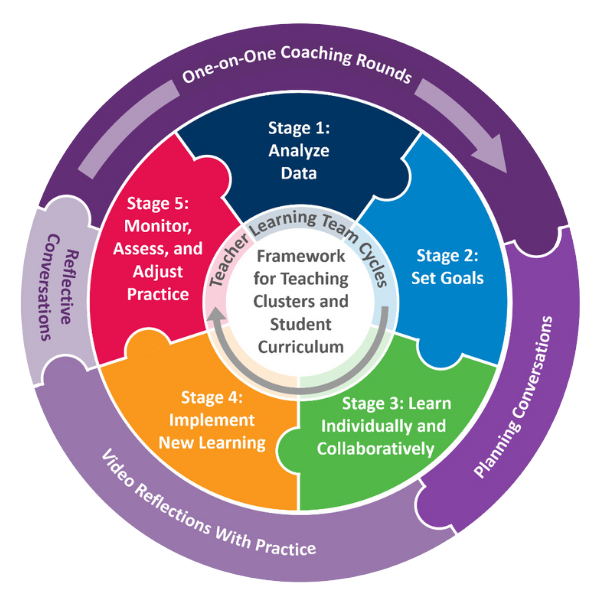
The 5-stage Inquiry Cycle
The PLI coaches were expected to lead grade-level teams through a 5-stage inquiry cycle which could provide continuity across the meetings. Many models for professional learning communities use similar inquiry cycles. The meetings, supported by structured protocols, are designed to foster collaborative learning and goal achievement.
What is the PLI program?
The PLI program was developed by two organizations at the forefront of teacher professional learning.
The Danielson Group and Learning Forward used resources developed by both organizations to create the PLI program.
The active ingredient in the PLI program is The Danielson Group's FFT, a comprehensive tool for teacher self-assessment and reflection, observation and feedback, and collaborative inquiry that specifies several dimensions of an educator's professional practice. Prior randomized controlled trials have shown that feedback on teaching based on the FFT has positive impacts on student achievement.
To incorporate the FFT into additional approaches to professional learning, the Danielson Group and Learning Forward support local instructional coaches, who use the FFT while working with grade-level teams to implement two of the PLI program’s primary components. Specifically, the coaches:
- Facilitate cycles of collaborative inquiry through meetings of the grade-level teams in what are called teacher learning team (TLT) meetings; and
- Provide one-on-one coaching that uses the goals of the grade-level team as a starting point.
As part of the scaling phase, The Danielson Group and Learning Forward added a school leadership support component to the program.
The 5-stage Inquiry Cycle
The PLI coaches were expected to lead grade-level teams through a 5-stage inquiry cycle which could provide continuity across the meetings. Many models for professional learning communities use similar inquiry cycles. The meetings, supported by structured protocols, are designed to foster collaborative learning and goal achievement.
Challenge #1
School leadership engagement
Leading up to the scaling phase of the project, it became clear from interviews with program participants that one design challenge for the program was engagement of school leaders. About a third of coaches in an earlier project phase reported that there was no support for PLI from the principal at their school. One coach explained as follows:
“I'm not even sure that our principals…were even ever really provided an explanation of what PLI was...If you ask them what PLI is, they probably have no idea. I feel like the only people that know what PLI are, in my building, are me and the four teachers that are involved in this.”
That created problems with scaling, because principals’ support is needed to secure time for the program and build enthusiasm for it.
For the scaling phase of the project, the partners amended the program to include a role for school leaders.


Challenge #1
School leadership engagement
Leading up to the scaling phase of the project, it became clear from interviews with program participants that one design challenge for the program was engagement of school leaders. About a third of coaches in an earlier project phase reported that there was no support for PLI from the principal at their school. One coach explained as follows:
“I'm not even sure that our principals…were even ever really provided an explanation of what PLI was...If you ask them what PLI is, they probably have no idea. I feel like the only people that know what PLI are, in my building, are me and the four teachers that are involved in this.”
That created problems with scaling, because principals’ support is needed to secure time for the program and build enthusiasm for it.
For the scaling phase of the project, the partners amended the program to include a role for school leaders.
Challenge #2
Program complexity and time burden
The second major challenge for scaling the full PLI program was that district gatekeepers saw it as potentially overburdening teachers and coaches. When AIR began outreach for the project’s scaling phase in early 2023, many districts declined—including some that had just completed an earlier phase of the project.
They explained that it was hard to say yes because PLI involved so much staff time. The TLT meetings, one-on-one coaching, and activities for school leaders were too much. Schools had other important initiatives that competing for staff attention. Several districts said that they would like to be able to choose specific components of the program—just not the whole program.

AIR, Danielson Group, and Learning Forward reflected on this feedback and created an "a la carte" approach for the project’s scaling phase. To get more districts and schools to use the PLI program’s components, the partners let districts choose which specific PLI program components to implement and at what scale to implement them. AIR and the program providers partnered with four districts and learned from their experiences.
Challenge #2
Program complexity and time burden
The second major challenge for scaling the full PLI program was that district gatekeepers saw it as potentially overburdening teachers and coaches. When AIR began outreach for the project’s scaling phase in early 2023, many districts declined—including some that had just completed an earlier phase of the project.
They explained that it was hard to say yes because PLI involved so much staff time. The TLT meetings, one-on-one coaching, and activities for school leaders were too much. Schools had other important initiatives that competing for staff attention. Several districts said that they would like to be able to choose specific components of the program—just not the whole program.
AIR, Danielson Group, and Learning Forward reflected on this feedback and created an "a la carte" approach for the project’s scaling phase. To get more districts and schools to use the PLI program’s components, the partners let districts choose which specific PLI program components to implement and at what scale to implement them. AIR and the program providers partnered with four districts and learned from their experiences.
Four insights from four district experiences
In the stories of these four districts, there are several insights about scaling professional learning programs such as PLI. Each district had different reasons for trying specific PLI components, and each encountered different challenges and successes.

Three of the four districts indicated that they are likely to continue to use some aspects of the PLI program in the upcoming school year. The fourth district needed more time to consider, as they already had a contract in place for the upcoming school year to begin a separate coaching model.
Based on the experiences of these districts, the following insights were gleaned about how to scale teacher professional learning based on the FFT.

Insight 1:
Design programs to engage school leaders throughout implementation.
One of the primary scaling insights from an earlier phase of the project was the importance of building a role for school leaders to ensure their engagement in implementing the components of the program. School leaders can help secure time for coaches and teachers to implement the components and integrate the work with other school priorities. This insight led to the development of a leadership component offering alongside the TLT meetings and one-on-one coaching components for districts participating in the 2023–24 school year.
In practice, all but one of the districts chose the leadership component as one of the a la carte components, acknowledging the importance of engagement of and support for school leaders to facilitate implementation and ultimately, scaling. However, it also became clear that engaging school leaders in the leadership component requires lead time (see Insight 4).

Insight 2:
Let districts choose components a la carte.
Each program component—TLT meetings, one-on-one coaching, and school leader engagement—may or may not fit in a specific context. Districts see themselves as having specific areas of need. They also have ongoing practices they want to continue. Thus, offering PLI as a whole program only—all or nothing—makes scaling difficult. Conversely, offering a menu makes it easier.
The following are short illustrations from the case studies:
- One district identified a need to build instructional coaching skills and start to establish a consistent approach to coaching. For this district, the PLI program itself was too much, but the FFT-based coaching fit a current need.
- Another district saw two PLI components—TLT meetings and school leadership team support—as missing pieces of their school leadership practices. The district had no interest in the PLI coaching model, but it appreciated the integration of the PLI support for the leadership team and the ability to put the strategies into practice right away through the grade-level TLT meetings.

Insight 3:
Allow districts to start small.
Districts were also receptive to the opportunity to start small. A district could start with one component of PLI, as described in Insight 2. In addition, districts wanted to limit the initial scale of implementation to a specific number of schools or grade-levels, for example, or limit the initial commitment required of coaches. The following are short illustrations from the case studies:
- The district that chose to only implement the FFT-based coaching asked each coach to try the one-on-one coaching with a single teacher. The purpose of limiting coaches to one teacher each was to avoid overloading coaches. Using this approach to starting small, the district was successful in getting coaches to participate in and gain knowledge of the PLI program’s FFT-based coaching.
- Two districts selected a single school to experience the selected program components, with one of the schools focusing only on two grade levels. The small-scale start-up was a way for the district and school leaders to see (a) how the program components fit their needs and (b) consider what they might like to expand to additional grade levels and schools.

Insight 4:
Make time for advance planning.
Even when starting on a small scale, implementing a new professional learning practice requires advance planning. Lead time allows champions of the new practice to develop buy-in from stakeholders and participants, identify key staff (e.g., coaches), or adjust programming that could interfere with the new practice. Two districts had difficulties that could be traced back to the short timeline available for planning and implementation:
- One district that tried to begin implementation midway through the school year recommended that, in the future, coach and teacher training be scheduled close to the start of the school year. By beginning at the start of the school year, the new program can be integrated into plans and priorities for the year ahead.
- Another district that started during the school year found that it was challenging to implement the leadership component due to competing priorities. If plans had been discussed and set before the start of the school year, it may have been easier to ensure that program implementation was integrated as a complementary rather than competing priority area.

Four insights from four district experiences
In the stories of these four districts, there are several insights about scaling professional learning programs such as PLI. Each district had different reasons for trying specific PLI components, and each encountered different challenges and successes.
Three of the four districts indicated that they are likely to continue to use some aspects of the PLI program in the upcoming school year. The fourth district needed more time to consider, as they already had a contract in place for the upcoming school year to begin a separate coaching model.
Based on the experiences of these districts, the following insights were gleaned about how to scale teacher professional learning based on the FFT.


Insight 1:
Design programs to engage school leaders throughout implementation.
One of the primary scaling insights from an earlier phase of the project was the importance of building a role for school leaders to ensure their engagement in implementing the components of the program. School leaders can help secure time for coaches and teachers to implement the components and integrate the work with other school priorities. This insight led to the development of a leadership component offering alongside the TLT meetings and one-on-one coaching components for districts participating in the 2023–24 school year.
In practice, all but one of the districts chose the leadership component as one of the a la carte components, acknowledging the importance of engagement of and support for school leaders to facilitate implementation and ultimately, scaling. However, it also became clear that engaging school leaders in the leadership component requires lead time (see Insight 4).
Insight 2:
Let districts choose components a la carte.
Each program component—TLT meetings, one-on-one coaching, and school leader engagement—may or may not fit in a specific context. Districts see themselves as having specific areas of need. They also have ongoing practices they want to continue. Thus, offering PLI as a whole program only—all or nothing—makes scaling difficult. Conversely, offering a menu makes it easier.
The following are short illustrations from the case studies:
- One district identified a need to build instructional coaching skills and start to establish a consistent approach to coaching. For this district, the PLI program itself was too much, but the FFT-based coaching fit a current need.
- Another district saw two PLI components—TLT meetings and school leadership team support—as missing pieces of their school leadership practices. The district had no interest in the PLI coaching model, but it appreciated the integration of the PLI support for the leadership team and the ability to put the strategies into practice right away through the grade-level TLT meetings.
Insight 3:
Allow districts to start small.
Districts were also receptive to the opportunity to start small. A district could start with one component of PLI, as described in Insight 2. In addition, districts wanted to limit the initial scale of implementation to a specific number of schools or grade-levels, for example, or limit the initial commitment required of coaches. The following are short illustrations from the case studies:
- The district that chose to only implement the FFT-based coaching asked each coach to try the one-on-one coaching with a single teacher. The purpose of limiting coaches to one teacher each was to avoid overloading coaches. Using this approach to starting small, the district was successful in getting coaches to participate in and gain knowledge of the PLI program’s FFT-based coaching.
- Two districts selected a single school to experience the selected program components, with one of the schools focusing only on two grade levels. The small-scale start-up was a way for the district and school leaders to see (a) how the program components fit their needs and (b) consider what they might like to expand to additional grade levels and schools.
Insight 4:
Make time for advance planning.
Even when starting on a small scale, implementing a new professional learning practice requires advance planning. Lead time allows champions of the new practice to develop buy-in from stakeholders and participants, identify key staff (e.g., coaches), or adjust programming that could interfere with the new practice. Two districts had difficulties that could be traced back to the short timeline available for planning and implementation:
- One district that tried to begin implementation midway through the school year recommended that, in the future, coach and teacher training be scheduled close to the start of the school year. By beginning at the start of the school year, the new program can be integrated into plans and priorities for the year ahead.
- Another district that started during the school year found that it was challenging to implement the leadership component due to competing priorities. If plans had been discussed and set before the start of the school year, it may have been easier to ensure that program implementation was integrated as a complementary rather than competing priority area.
District Stories
Scroll through to explore what each school shared about their experience with PLI program components.
District A prepared coaches to use the FFT-based coaching component by starting small, with one teacher per coach.
District A first joined the project during an earlier phase in 2021–22. Some coaches and teachers used the program for 2 years, including the TLTs and, to a lesser extent, the one-on-one coaching.
When asked whether the district would be interested in continuing to implement one or more components in the 2023–24 school year, district leaders reflected on the offer and concluded that the one-on-one coaching component embedded within PLI was something that all of the district’s coaches could benefit from experiencing. District leaders said that the features of coaching that were particularly important for coaches to learn were the use of the FFT, goal setting (individual or group goals), and the use of classroom video recordings to help teachers reflect on their teaching
District A has a well-established practice of supporting its teachers with instructional coaches. Across three school levels (K-2, 3-5, and middle schools), the district employs approximately two coaches for every three elementary schools.
The challenge for district leaders was how to support coaches in a way that would lead them to embrace the PLI coaching practices. During the project’s earlier phase, some coaches didn’t fully implement the one-on-one coaching and expressed that they didn’t have enough time to serve all of the teachers they were coaching. The PLI model in that phase required a coach to support a whole grade level of teachers not just through group meetings but also through several cycles of one-on-one coaching.
So, for the 2023–24 school year, District A’s leader acknowledged that concern and figured out a way to achieve their goals while minimizing the time commitment needed from coaches. The district leader wanted coaches to learn the PLI one-on-one coaching model and felt that this could be done serving just one teacher per coach. To make it even less challenging, the district leader asked each coach to pick a teacher with whom the coach had already built trust. For 2023–24, each of 13 coaches supported one teacher.
With a single teacher per coach, the district was successful in getting coaches to try the program. About half of the teachers reported that coaches met with them at least once per week, and the other half reported meeting two or three times per month. Teachers were positive about the program, reporting that their coach helped them reflect on their teaching in a way that made them understand things about their teaching that the teacher otherwise would not have noticed or thought about.
The district seems poised to continue with some features of PLI including the FFT as well as the one-on-one coaching strategy of using video-recordings of instruction as a tool for reflection. One district leader shared,
“Our hope is that we can continue to scale it and continue to help impact instruction across the district.”
District B used the FFT in one school to support the leadership team and to guide grade-level teams.
Before joining the project, central office leaders in District B had a vision for their school leadership teams. They wanted the school leadership teams to oversee grade-level teams, each of which would follow a systematic process for support and collaboration.
That vision was on leaders’ minds when AIR, Danielson Group, and Learning Forward approached the district about receiving support to implement PLI program components in the 2023–24 school year. The district leaders saw two components of PLI as likely useful: PLI’s leadership and TLT components. These fit well with the district leaders’ vision as well as their intent to support the use of student data to drive instruction.
District B decided to try out two PLI components—leadership and TLTs—in one school. That school engaged each of its grade-level teams in K–4. The central office leaders wanted to learn from the experience, so they joined the principal and coaches in all of the school leadership team trainings with Learning Forward and Danielson Group specialists, but not the coaching support provided by the partners for the grade-level TLT cycle work.
The school staff received training and support for grade-level teams, and the teams followed the PLI cycle designed to organize the meetings, including setting group goals and individual teacher goals.
The district and school leaders had positive things to say about PLI and how the support for the school leadership team and TLTs worked as a system, like a set of “nested Russian dolls,” allowing leadership priorities to be put into practice right away with the TLTs. At the same time, they learned that it would require setting aside time for the PLI activities and setting an intentional pace to complete the full TLT cycle.
As of spring 2024, district leaders said that they expect to scale both components—school leadership team support and TLTs—across the district next year.
District C experienced some challenges with implementing all three components of the PLI program to build capacity within one school’s instructional team.
A school leader in District C was looking for a way to strengthen the capacity of their instructional team when they learned about PLI at a conference. After learning more about PLI, district leaders and the school leader agreed to try all of the components of the PLI program in the one elementary school. This would help them build the capacity of coaches (e.g., to observe instruction objectively and take specific actions), and it would give the district experience with the PLI model for future consideration even though another 2-year, district-wide coaching model was in place.
The principal asked three coaches and six teachers across two grade levels to participate in the TLTs and one-on-one coaching. The principal was especially eager to see the coaches work with teachers as a group to articulate a common goal. The principal also liked how the leadership team walkthroughs identified a clear focus for their efforts: student engagement, especially via student-to-student interactions.
The district experienced some delays in beginning implementation which limited the time to fully experience the program. Some coaches and teachers also seemed reluctant to participate at first. One issue was the timing of the PLI training, which did not begin until December 2023. This meant that trainings were scheduled just before the winter holidays and just before spring student testing.
Teachers also expressed frustration to leadership about being asked to participate in make-up sessions for other district professional learning, due to a scheduling conflict with a PLI training. In retrospect, district and school leadership think the program would have been better received if it had begun closer to the start of the school year.
School and district leaders identified a few lessons learned from early implementation efforts, including the need to provide more clarity on the expectations and timeline for coaches (i.e., an overview of the whole process, the order of steps, and a concrete timeline) as well as building teacher buy-in by starting the program with teachers who are already successful and have a strong voice to share what they are learning.
District D experienced some challenges implementing the whole PLI program in three schools.
Similar to District A, District D agreed to participate during the 2023–24 school year after participating in an earlier phase of the project. The participants from the earlier implementation had reported that PLI was a positive experience, so district leaders were responsive when AIR, Danielson Group, and Learning Forward approached the district about implementing components of PLI in 2023–24. The district leaders talked with schools, and three schools decided to participate.
The school that AIR selected to interview about their experience had implemented the program in an earlier phase. The coach already knew how to facilitate the TLTs and implement the one-on-one coaching. The school decided to implement all three program components in the 2023–24 school year and to focus on two grade levels. The principal chose these grade levels because the two teacher teams seemed ready to identify and pursue a team goal. One grade level had implemented the program in the prior phase of the project.
Like District C, District D experienced delays in beginning implementation and did not start until December 2023. At the time of the interviews, the school had not yet participated in all components. They completed several TLT meetings but had done relatively little of the one-on-one coaching. In addition, the PLI leadership component was not fully implemented due to competing priorities at the school.
The school staff reported that the program helped them in some specific ways. It provided structure for team meetings and for coaching and the FFT provided useful language. However, there were other features of the program that reportedly did not go well. For example, the school had chosen to give teachers the option to be observed in person by the coach rather than to submit a video to the coach. That resulted in time lost because scheduling proved difficult.
Also, one aspect of PLI that staff may modify in the future is the use of the Knowledge, Attitudes, Skills, Aspirations, and Behaviors (KASAB) model that is embedded in the protocol for the TLT meetings. Staff indicated that the KASAB model was not particularly impactful for them.
We asked school staff to share the extent to which the district or their school plans to continue to implement the PLI program components in the future. School staff indicated they plan to continue to implement the use of and emphasis on data, use TLT cycles to engage and work with teachers, determine data-based goals, and monitor progress.
School leadership described their vision for continuing the one-on-one coaching as a way for teachers to have lessons that are more aligned, while also looking at student work to make modifications on a more regular basis. School leadership articulated the importance of continuing the practice of
“...the coach meeting with the teachers and being able to have the goal and using the protocol that [the coach] uses when meeting with them and having a shared document.”



AIR
Discover more AIR research projects related to teacher professional development.

The Danielson Group
The Danielson Group works with school systems across the country and around the world to empower their teachers to be their best by creating professional learning programs and policies that provide the right levels of support all along a teacher's career path. Learn more about their updated Framework for Teaching (FFT).

Learning Forward
Find out more about Learning Forward, an organization that shows you how to plan, implement, and measure high-quality professional learning so you and your team can achieve success with your system, your school, and your students.
Disclaimer
The contents of this digital story were developed under a grant from U.S. Department of Education, Office of Elementary and Secondary Education, Award No. U411B180032; however, those contents do not necessarily represent the policy of the Department of Education and you should not assume
endorsement by the Federal Government.
 Built with Shorthand